If you’ve ever wondered how the finalists are selected, here’s a rundown of the process:
Eligible members of the Richmond Theatre Community Circle vote for nominees and award recipients at the end of every theater season. Members include local writers and critics who have achieved membership in the organization as well as a regularly renewing number of members making up what is called the “TAP,” which stands for the Theatre Alliance Panel. These participants are community members who are not affiliated with any theater company. They’re nominated by the leadership of RVA On Stage (formerly the Richmond Theatre Alliance) and attend the eligible shows. As with the critics, they must have seen 2/3 of the eligible shows to vote. CLICK HERE for a list of critics and TAP members.
Nominations
The RTCC meets to select nominees and award winners after the official end of the season, which is July 31st. RTCC members rank their top 3 choices in most categories; the major acting categories are not specified by gender and each member is allowed up to 5 top choices in those categories.
Each ranked choice is given a point value – 3 points for a choice ranked 1st, 2 points for a choice ranked 2nd and 1 point for a choice ranked 3rd. The points are then tallied from these ranked choices.
A weighted average is then used to make final selections. The number of points a potential nominee has earned is divided by the number of RTCC members who saw the production that is associated with the nomination.
So, for example, a production vying for Best Musical is ranked 1st by 2 members and 2nd by 2 members. Five members saw this show. The show’s weighted average would be 2.0 ( (2 x 3) + (2 x 2) = 10 / 5 = 2.0).
Another show is ranked 1st by 2 members and they were the only people in the RTCC who saw the show. That show’s weighted average would be 3.0 ( (2 x 3) = 6 / 2 = 3.0).
All of these choices are compiled on a spreadsheet which reveals the top nominations in each category.
The RTCC reviews the spreadsheet with each voter’s choices and:
- For most categories, if there’s a clear group of 5 with the highest score in a category, those are the nominations. For the major acting categories, 8-10 nominees are generally selected.
- If there are ties or close totals resulting in more than the typical number of nominations, we discuss the merits of the top scorers. Members can also suggest that the category be extended to more than the typical number of nominees.
- While the final slate of nominees in any category is still in question, any member can make an “impassioned plea,” where they can either endorse or disparage a choice with the aim of getting others to change their vote. The goal is to both reduce the final number to the typical limit and to make sure those chosen are the consensus choice.
- Voters can review their choices and make changes. If there are ties and nobody is willing to adjust their scores, the number of nominees is automatically extended to include those options with tied scores.
Award Recipients Selected
After nominees are finalized, each category of nominees is considered in turn and NO options other than those chosen as nominees are considered at this point. Critics may redistribute their votes if one of their chosen nominees did NOT end up in the final list.
The vote totals are tallied:
- If the category has one clear top nominee (two for the major acting categories), that nominee is declared the winner.
- If more than one nominee (two for the major acting categories) has the same or nearly the same number of points, members can suggest that the category be extended to allow more than the usual number of winners.
- If there’s still a stalemate, the president will call for impassioned pleas. Members can respond to endorse or disparage a choice, aiming to get others to change their vote. The goal is to both reduce the category to the typical numbers of winners and to make sure the winners reflect the consensus.
- After pleas are heard, members can elect to change their votes.
The results are final. Either a single nominee (2 for the major acting categories) is identified as the award recipient or a tie is confirmed. The nominations are published, which begins the anticipation of the final announcements at the Artsies Awards.
Example
Below is a hypothetical voting scenario. There are 7 options in consideration for Best Musical. In the “#” column, each voter has indicated what rank (if any) they would give each option. In the “Y” column, they have indicated whether they saw the production in question.
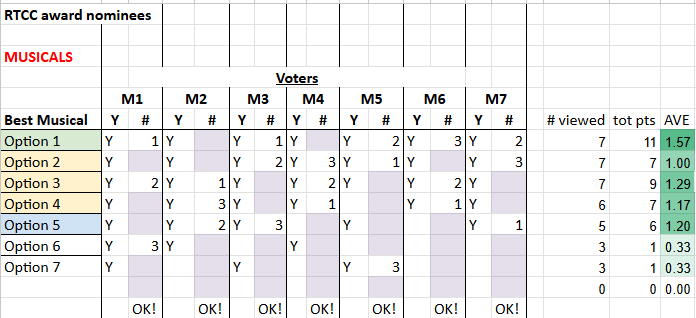
In this example, Musical options #1 through #5 received the highest weighted averages. Unless there was further discussion about these results, those options would be the nominees in this category.
Musical #1 received 11 total points (ranked 1st twice, 2nd twice and 3rd once) and the show was seen by all of the members. Its weighted average of 1.57 is the highest.
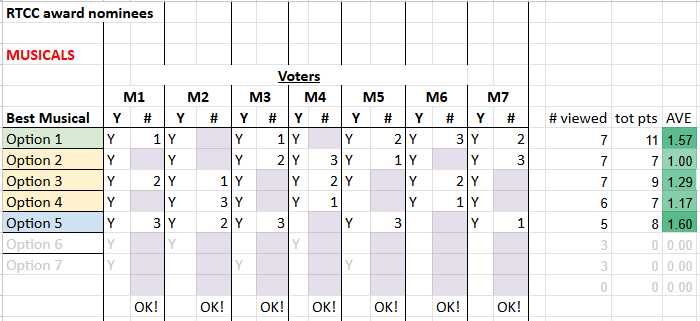
However, after the nominees are narrowed down to the top 5 options, members can redistribute their votes. In the image below, both member #M1 and member #M5 have made Musical #5 their third choice. That show’s weighted average is now higher than Musical #1. The margin of difference is so slim, though, that additional deliberation would be needed to assure that Musical #5 is indeed the consensus choice.
Revised June 2026